
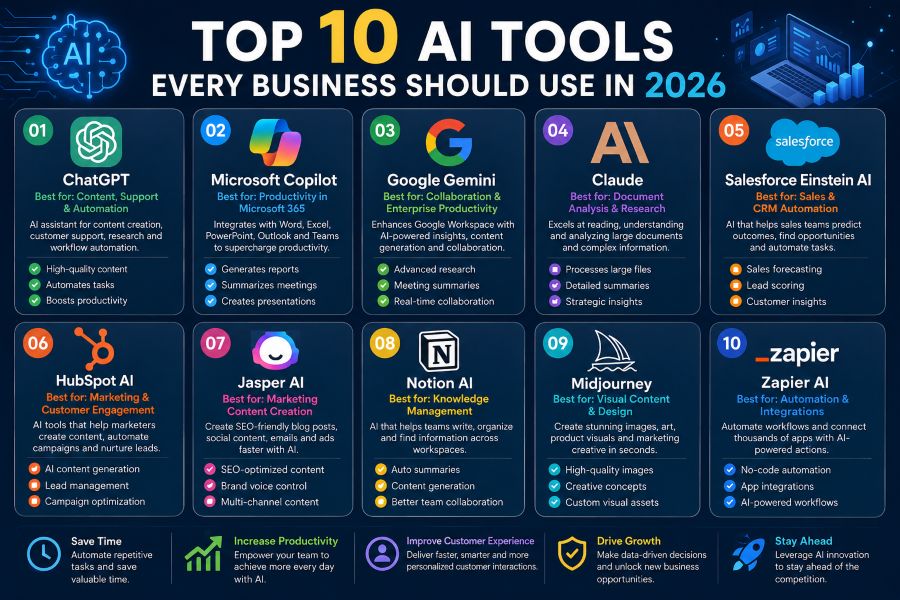
Top 10 AI Tools Every Business Should Use in 2026
Introduction
Artificial Intelligence has evolved from a competitive advantage to a business necessity. In 2026, organizations of every size are leveraging AI to automate tasks, improve customer experiences, increase productivity, and drive innovation. Companies that embrace AI are reducing operational costs while gaining valuable insights that help them make smarter decisions.
Whether you’re a startup founder, a small business owner, or an enterprise executive, these ten AI tools can help transform the way your business operates.
1. ChatGPT
Best For:
Content creation, customer support, research, brainstorming, and workflow automation.
ChatGPT has become one of the most versatile AI assistants available. Businesses use it to generate marketing content, draft emails, create reports, analyze data, and provide customer support.
Key Benefits:
- Creates high-quality content quickly
- Automates repetitive communication tasks
- Enhances employee productivity
- Supports multiple languages
Business Impact:
Companies report significant time savings and improved efficiency across departments.
2. Microsoft Copilot
Best For:
Productivity within Microsoft 365 applications.
Microsoft Copilot integrates directly into Word, Excel, PowerPoint, Outlook, and Teams, helping employees work smarter and faster.
Key Benefits:
- Generates reports automatically
- Summarizes meetings
- Creates presentations in minutes
- Analyzes spreadsheets instantly
Business Impact:
Reduces administrative workload and accelerates decision-making.
3. Google Gemini
Best For:
Research, collaboration, and enterprise productivity.
Google Gemini enhances Google Workspace by providing intelligent assistance across Docs, Sheets, Gmail, and Meet.
Key Benefits:
- Advanced information retrieval
- Document generation
- Meeting summaries
- Real-time collaboration support
Business Impact:
Improves team productivity and streamlines workflows.
4. Claude
Best For:
Document analysis and enterprise knowledge management.
Claude excels at understanding large volumes of information, making it ideal for legal, consulting, finance, and research-focused organizations.
Key Benefits:
- Processes lengthy documents
- Generates detailed summaries
- Supports strategic analysis
- Provides thoughtful responses
Business Impact:
Accelerates research and knowledge discovery
5. Salesforce Einstein AI
Best For:
Sales, CRM automation, and customer intelligence.
Einstein AI helps sales teams predict customer behavior, automate follow-ups, and identify new opportunities.
Key Benefits:
- Sales forecasting
- Lead scoring
- Customer insights
- Workflow automation
Business Impact:
Increases sales efficiency and improves customer relationships.
6. HubSpot AI
Best For:
Marketing automation and customer engagement.
HubSpot’s AI tools help businesses create campaigns, optimize content, and nurture leads more effectively.
Key Benefits:
- AI-generated marketing content
- Automated customer interactions
- Enhanced lead management
- Campaign optimization
Business Impact:
Drives higher conversion rates and marketing ROI.
7. Jasper AI
Best For:
Marketing content creation.
Jasper is designed specifically for marketers who need blog posts, social media content, email campaigns, and advertising copy.
Key Benefits:
- SEO-focused writing
- Brand voice customization
- Multi-channel content generation
- Faster content production
Business Impact:
Enables marketing teams to scale content efforts efficiently.
8. Notion AI
Best For:
Knowledge management and team collaboration.
Notion AI transforms note-taking and documentation by helping teams organize information and generate insights.
Key Benefits:
- Automatic summaries
- Content generation
- Project organization
- Team collaboration enhancement
Business Impact:
Improves knowledge sharing and workplace productivity.
9. Midjourney
Best For:
Visual content creation and design.
Businesses increasingly use Midjourney to create marketing graphics, product concepts, branding materials, and social media visuals.
Key Benefits:
- Rapid image generation
- Creative concept development
- Reduced design costs
- High-quality visual assets
Business Impact:
Speeds up creative workflows and enhances brand presentation.
10. Zapier AI
Best For:
Business process automation.
Zapier connects thousands of applications and now incorporates AI capabilities that automate complex workflows.
Key Benefits:
- No-code automation
- Cross-platform integrations
- AI-driven workflows
- Reduced manual tasks
Business Impact:
Allows teams to focus on strategic work instead of repetitive processes.
How to Choose the Right AI Tool
Before investing in AI solutions, consider:
Business Goals
Identify specific challenges you want AI to solve.
Integration Capabilities
Choose tools that work seamlessly with your existing systems.
Scalability
Select solutions that can grow alongside your business.
Security and Compliance
Ensure the platform meets your organization’s security requirements.
Return on Investment
Measure potential productivity gains against implementation costs.
The Future of AI in Business
Artificial Intelligence is no longer optional for organizations seeking long-term competitiveness. Businesses that successfully integrate AI into their operations will benefit from increased efficiency, stronger customer relationships, better decision-making, and accelerated innovation.
As AI technology continues to evolve, the gap between AI-enabled businesses and those that resist adoption will continue to widen. The time to embrace AI is now.
Final Thoughts
The most successful companies in 2026 are not replacing people with AI—they are empowering people with AI. By strategically implementing the right tools, businesses can unlock new levels of productivity, creativity, and growth.
Whether you’re just beginning your AI journey or looking to expand your existing capabilities, these ten AI tools provide a strong foundation for building a smarter and more competitive organization.
Leave a Reply
You must be logged in to post a comment.