
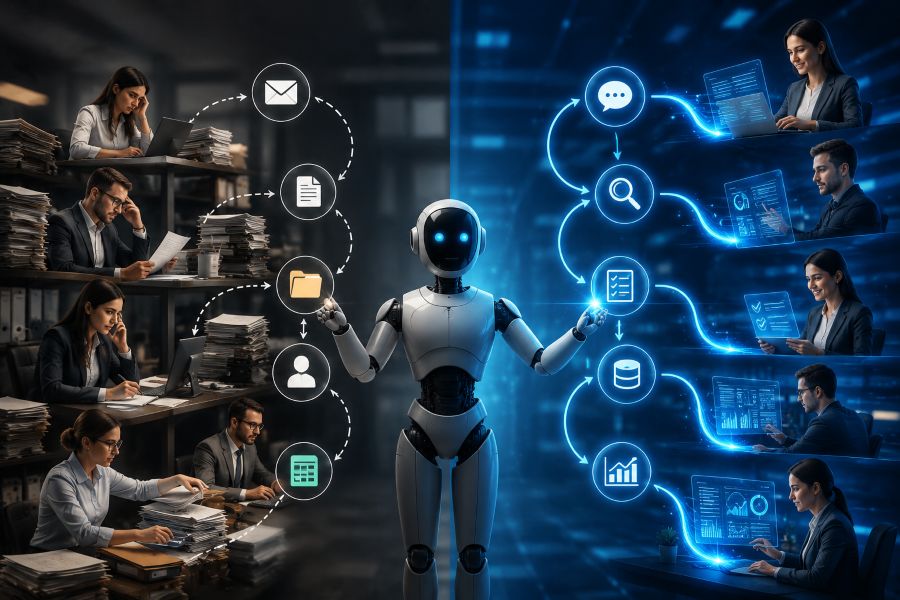
How AI Agents Are Replacing Traditional Workflows
Introduction
The workplace is undergoing one of the most significant transformations since the advent of the internet. Artificial Intelligence (AI) has moved beyond simple automation tools and evolved into intelligent agents capable of performing complex tasks, making decisions, and collaborating with humans.
In 2026, AI agents are no longer experimental technologies—they are becoming essential business assets. Organizations across industries are deploying AI agents to streamline operations, reduce costs, improve customer experiences, and accelerate growth.
But what exactly are AI agents, and how are they replacing traditional workflows?
What Are AI Agents?
AI agents are intelligent software systems that can perceive information, analyze data, make decisions, and take actions with minimal human intervention.
Unlike traditional automation, which follows predefined rules, AI agents can:
- Understand natural language
- Learn from data
- Adapt to changing situations
- Perform multi-step tasks
- Collaborate with other systems
- Make recommendations and decisions
Think of AI agents as digital employees capable of handling both routine and complex business processes.
Traditional Workflows vs. AI-Agent Workflows
Traditional Workflow
A customer submits a request:
- Customer sends email
- Employee reads request
- Employee gathers information
- Employee updates systems
- Employee sends response
- Manager reviews outcome
This process may take hours or even days.
AI-Agent Workflow
- AI agent receives request
- AI analyzes customer intent
- AI gathers required information
- AI updates systems automatically
- AI generates response
- Human reviews only exceptions
The same process can often be completed within minutes.
Why Businesses Are Adopting AI Agents
Increased Productivity
AI agents operate 24/7 without fatigue, enabling organizations to handle more work without increasing headcount.
Faster Decision-Making
AI agents process vast amounts of data in seconds, providing insights that would take humans hours to generate.
Reduced Operational Costs
Companies can automate repetitive tasks, allowing employees to focus on higher-value activities.
Improved Customer Experience
AI-powered systems respond instantly and consistently, reducing wait times and improving satisfaction.
Five Traditional Workflows Being Replaced by AI Agents
1. Customer Support
Traditional support teams spend significant time answering repetitive questions.
AI agents can:
- Handle common inquiries
- Resolve basic issues
- Escalate complex cases
- Operate around the clock
Result:
Faster responses and lower support costs.
2. Sales Prospecting
Sales teams traditionally spend hours researching leads.
AI agents can:
- Identify potential customers
- Analyze buying signals
- Personalize outreach
- Schedule follow-ups
Result:
More qualified leads and increased sales productivity.
3. Marketing Operations
Marketing teams manage content creation, campaign monitoring, and audience analysis.
AI agents can:
- Generate content
- Optimize campaigns
- Analyze performance
- Recommend improvements
Result:
Higher marketing efficiency and better ROI.
4. Human Resources
Recruitment and onboarding involve extensive administrative work.
AI agents can:
- Screen resumes
- Schedule interviews
- Answer candidate questions
- Assist employee onboarding
Result:
Faster hiring and improved employee experiences.
5. Financial Operations
Finance departments process invoices, reports, and compliance documentation.
AI agents can:
- Process transactions
- Detect anomalies
- Generate reports
- Monitor compliance requirements
Result:
Greater accuracy and reduced processing time.
The Rise of Autonomous Workflows
The next stage of AI evolution is autonomous workflows.
Instead of automating individual tasks, AI agents now manage entire processes from start to finish.
For example:
A customer places an order.
An AI agent can:
- Verify inventory
- Process payment
- Arrange shipping
- Update customer records
- Send notifications
- Monitor delivery status
All without human intervention.
This level of automation creates faster, more scalable business operations.
Industries Being Transformed by AI Agents
Healthcare
- Patient scheduling
- Medical documentation
- Clinical decision support
Finance
- Fraud detection
- Risk assessment
- Investment analysis
Retail
- Inventory optimization
- Personalized recommendations
- Customer service
Manufacturing
- Predictive maintenance
- Quality control
- Supply chain management
Education
- Personalized learning
- Student support
- Administrative automation
Challenges Businesses Must Address
Data Security
AI systems require access to sensitive information, making cybersecurity a top priority.
Governance
Organizations must establish clear policies regarding AI decision-making and accountability.
Human Oversight
AI agents should augment human capabilities rather than operate entirely without supervision.
Employee Training
Workers need new skills to effectively collaborate with AI technologies.
What the Future Looks Like
Experts predict that organizations will increasingly rely on teams consisting of both human employees and AI agents.
Rather than replacing workers entirely, AI agents will take over repetitive and administrative tasks, enabling people to focus on:
- Strategic thinking
- Innovation
- Creativity
- Relationship building
- Leadership
Businesses that embrace this hybrid workforce model will likely gain significant competitive advantages.
Conclusion
AI agents are fundamentally changing how work gets done. By replacing traditional workflows with intelligent, autonomous systems, organizations can improve efficiency, reduce costs, and deliver better customer experiences.
The question is no longer whether AI agents will transform business operations—it is how quickly companies can adapt and leverage their potential.
The future workplace will not be powered by humans alone. It will be powered by humans and AI agents working together to achieve outcomes that neither could accomplish independently.
Leave a Reply
You must be logged in to post a comment.